

Women on Wheels Vocational Training
Empowering refugee women in Kampala with tailoring, entrepreneurship, and financial management skills. Through free, hands-on training and trauma-informed support, participants gain the tools, confidence, and mental well-being needed to build sustainable livelihoods and transform their futures.
What's the issue:
Refugee Women
51% of refugees in Uganda are female, out of 1,999,576 refugees and asylum seekers
Mental Health Crisis
Uganda is experiencing a severe mental health crisis, with over 14 million people (nearly 32% of the population) affected by mental illness, including high rates of anxiety, depression, and suicide among youth.
Financial inclusion and education
Women in Uganda have less access to formal financial services and, often, lower levels of education, which creates a double barrier.
Uganda's Unemployment
In Uganda, 41% of people live in poverty, and almost half of Uganda’s population is under the age of 15, representing one of the youngest populations in the world. Uganda also hosts the largest refugee population in Africa.
Language Gaps
Refugees in Uganda speak a diverse range of languages, primarily dictated by their country of origin, with major groups speaking Arabic, French, Swahili, Kakwa, Lugbara, and various Congolese languages. Many refugees, particularly in urban areas like Kampala, are multilingual, but struggle with English when accessing official services.
Social Networks and Resourcing
Uganda, and refugees in particular, are experiencing a concerning trend with the diminishing presence of recreation centres, posing a threat to the well-being and social fabric of its communities.
Many refugees, particularly women, arrive in Uganda with intense stress, trauma, language gaps, social networks, limited job histories, and non-transferable skills, making it difficult to find opportunities for employment, life in a new country.
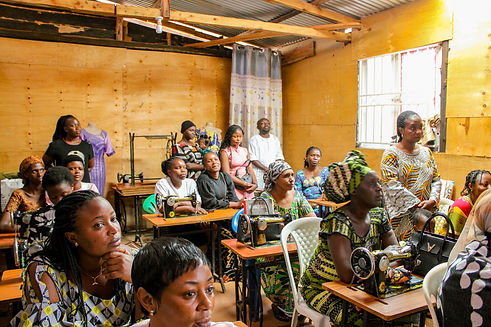
The Women on Wheels Vocational Training Program is a comprehensive, trauma-informed initiative designed to equip vulnerable refugee women in Kampala with vocational skills, business literacy, and financial independence. Through intensive training in tailoring, combined with a practical 12-module curriculum in entrepreneurship and financial management, the program aims to transform the economic futures of refugee women and their households. At no cost, participants receive hands-on training in tailoring, along with all necessary equipment, materials, and tools, including sewing machines and fabrics. Training is delivered by experienced instructors and mentors, ensuring that each participant gains both technical skills and the confidence to use them in real-world settings.
We also embed mental health workshops into SEF’s Women on Wheels vocational training program, which serves 150+ refugee women in tailoring and fashion design. These workshops are intentionally designed to provide psychological safety, create trauma-informed support networks, and offer safe spaces for participants to express themselves, reduce stress, and form meaningful, long-term relationships with peers who share similar life experiences.
Combining these efforts, with great care, centering the needs and voices of our community, we are committed to:
1. Contribute and accelerate the United Nations Sustainable Development Goals, Goal 1 and Goal 10, End Poverty through Reduced Inequalities; income inequalities for vulnerable refugees, especially women.
2. Provide additional psychological rings of support to vulnerable refugees currently on a journey to heal the wounds caused by conflict, and furthermore, grow their network and form key friendships, relationships for life.
3. Boost refugee women's confidence and competence to run and manage small-medium income-generating activities, equipping them tools, connections and resources needed to achieve a great sense of self-reliance.